
Heating system fit
What flow and return temperatures should you use in a heating survey?
You walk into a house to carry out a heating survey. There's a gas boiler in the kitchen, radiators in every room and perhaps a bedroom that never quite gets warm enough. You need to enter the heating system's flow and return temperatures. But what should you put?
The boiler might be set to 70°C, but that doesn't tell you the return temperature, what temperature reaches each radiator or what happens when the heating is working flat out on a cold winter's day. Yet those two numbers can make the difference between a radiator being perfectly adequate and needing replacement with something more than twice the rated output.
That's the problem with flow and return temperatures in a heating survey. They're often design assumptions rather than measurements, and changing them can completely change the radiator assessment without changing the building's heat loss.
The short answer
Flow temperature is the temperature of the water supplied from the heat source to the heating system. Return temperature is the temperature of the water coming back after passing through the system and giving up some of its heat. A system described as 60/50°C has a design flow temperature of 60°C and a return temperature of 50°C, a 10°C difference.
These temperatures matter because a radiator's output depends on how hot its water is compared with the room. Higher water temperatures mean more heat from the same radiator. Lower temperatures mean less. But there's an important distinction:
The distinction this whole guide rests on
Flow and return temperatures don't directly determine how much heat a house loses. They determine how much heat its radiators can deliver. That's why an existing radiator can be adequately sized at 75/65°C but badly undersized at 45/40°C, even though nothing about the house has changed.
Can you establish the actual temperatures during a survey?
Suppose you're surveying a house with a gas combi boiler and the central heating temperature is set to 70°C. That's useful information, but it doesn't tell you the whole story. The boiler may not continuously deliver 70°C: modern boilers modulate their output, and weather compensation or other controls may reduce the flow temperature when less heating is needed. Even when the boiler is delivering 70°C, you don't necessarily know the return temperature or whether every radiator receives the same flow temperature. The actual temperatures depend on water circulation, radiator valves, system balancing, heating demand and the way the controls operate.
You can investigate further. Contact thermometers can measure pipe temperatures, and thermal cameras can help identify temperature differences, although reflective pipe surfaces make accurate thermal readings difficult. You could even log temperatures over several days. But those measurements still describe how the system behaves under the conditions at the time. A heating system keeping the house warm when it's 10°C outside may behave very differently when it's −3°C.
For a routine heating survey, establishing the exact operating conditions at every radiator isn't usually practical. Fortunately, you don't need to know those temperatures to calculate the building's heat loss, and you can assess radiator capacity against proposed design temperatures instead.
Heat loss and radiator output are different calculations
A heat loss calculation establishes how much heat each room needs to maintain its design temperature when it's cold outside. Take a simplified four-room example:
| Room | Design heat loss |
|---|---|
| Living room | 1,500 W |
| Kitchen | 1,200 W |
| Bedroom 1 | 1,000 W |
| Bedroom 2 | 900 W |
| Total | 4,600 W |
These illustrative figures describe the heating demand at the chosen internal and external design conditions. Whether the property has a gas boiler, oil boiler or heat pump doesn't change that demand. Building heat loss depends on the building fabric, ventilation and design temperatures, covered in our guides to heat loss, converting a q50 result into air changes per hour and thermal bridging.
But if we want to know whether the existing radiators are big enough, we need to decide what water temperatures to assess them at. We might choose 75/65°C, 60/50°C or 45/40°C. At this stage we're assuming the radiators receive their specified design temperatures and sufficient water circulation under balanced conditions. We're not proving that the existing heating system can achieve those conditions. That's a separate part of system design and commissioning.
How much difference do flow and return temperatures make?
Take the living room, which needs 1,500 W of heat. It has an existing radiator rated at 2,000 W at ΔT50. ΔT50 is the standard radiator rating condition: a 50°C difference between the radiator's mean water temperature and the room temperature. Radiator outputs are declared under BS EN 442, so different radiators can be compared on a consistent basis.
Using a room temperature of 21°C and the standard correction exponent of 1.3, here's how the same radiator's output changes:
| Flow / return | Mean water temperature | Approx. radiator output |
|---|---|---|
| 75/65°C | 70°C | 1,948 W |
| 70/50°C | 60°C | 1,448 W |
| 60/50°C | 55°C | 1,211 W |
| 55/45°C | 50°C | 985 W |
| 45/40°C | 42.5°C | 668 W |
These are illustrative outputs using the simplified mean-water-temperature correction method. Actual radiator performance depends on manufacturer data and operating conditions.
At 75/65°C the radiator comfortably meets the room's 1,500 W heat loss. At 70/50°C it's slightly undersized. Drop to 60/50°C and it falls nearly 300 W short. At 45/40°C it delivers less than half the heat required. Same radiator, same room, same heat loss. The only thing we've changed is the assumed water temperatures. That's why your starting assumptions matter.
Why your radiator might need to be twice the size
Now imagine replacing the gas boiler with a heat pump and designing the system to operate at 45/40°C. The existing radiator, rated at 2,000 W at ΔT50, can only deliver approximately 668 W under those conditions. To meet the room's 1,500 W heat loss you'd need a radiator rated at around 4,500 W at ΔT50, assuming similar characteristics. That's more than twice the original rated output.
It doesn't necessarily mean a radiator twice as wide. You might choose a taller model, one with more panels and convectors, or a different type of emitter altogether. But it shows why radiator upgrades are so often part of converting a property to low-temperature heating. The heat pump hasn't made the house lose more heat. The radiator simply has a smaller temperature difference to work with.
Why not just turn the temperature up?
If hotter water means smaller radiators, why not design everything at 75/65°C? Because the heat source matters too.
For a modern condensing gas boiler, lower return temperatures let more heat be recovered from the flue gases. Condensing typically starts when the return falls below roughly 55°C, though the precise point depends on combustion conditions. So a system operating at 60/50°C has better potential for condensing operation than one returning water at 65°C.
Heat pumps are particularly sensitive to flow temperature. The hotter the water they have to produce, the harder they generally have to work, and the lower their coefficient of performance (COP). That's why lower flow temperatures are desirable for heat pumps, provided the radiators can still deliver enough heat. The trade-off is straightforward: lower water temperatures improve heat source efficiency, but the emitters may need to be larger.
What do CIBSE, MCS and Building Regulations say?
CIBSE Domestic Heating Design Guide 2026
The CIBSE guide covers room-by-room heat loss and heating system design, including the selection and sizing of heat emitters. The distinction it draws is between the heat a room requires and the output an emitter can provide at its selected design water temperatures. Emitter selection must account for those operating conditions rather than relying only on a radiator's nominal rated output.
MCS heat pump design: MIS 3005-D
MCS is more explicit about higher flow temperatures. MIS 3005-D Issue 3.0, clause 5.5.4, says high-temperature heat pumps should be avoided unless the application requires a flow temperature above 55°C. Clause 5.5.5 goes further: where a proposed system is designed to operate above 55°C, an alternative design at 55°C or below should also be provided, with the differences in efficiency and energy consumption explained to the customer. That doesn't mean every heat pump must operate at 55°C, or that 55°C is the ideal temperature. It means choosing a higher flow temperature has consequences worth examining.
What about Building Regulations?
In England, Approved Document L, Volume 1, 2021 edition incorporating the 2023 amendments, gives guidance on wet heating systems. Paragraph 5.10 says that where a wet heating system is newly installed or fully replaced, including the heating appliance, emitters and associated pipework, the system should be sized to meet the dwelling's heating needs at a maximum flow temperature of 55°C or lower. Where that isn't feasible in an existing dwelling, the guidance is to use the lowest practical design temperature that will meet the heating requirement.
A newer Approved Document L has been published, but it doesn't take effect for ordinary building work in England until 24 March 2027, subject to transitional arrangements. Its paragraph 4.10 retains the 55°C design-flow provision. None of this means an existing gas boiler installation must be converted to 55°C just because it's being surveyed. But it helps explain why lower-temperature radiator assessments are increasingly relevant. These references apply to England. Wales, Scotland and Northern Ireland have their own guidance, which should be checked for the project in hand.
Why does the return temperature matter?
It's easy to focus on flow temperature and treat the return as a secondary figure. But the difference between them affects both radiator output and the amount of water that has to circulate. The relationship is:
Heat transferred = mass flow rate × specific heat capacity × temperature drop (Q = ṁ × cp × ΔT)
Take a radiator delivering 1,500 W. If the water cools by 10°C as it passes through, it needs about 2.2 litres per minute flowing through it. If it cools by only 5°C, the required flow doubles.
| Heat output | Flow-to-return drop | Required water flow |
|---|---|---|
| 1,500 W | 20°C | 1.1 L/min |
| 1,500 W | 10°C | 2.2 L/min |
| 1,500 W | 5°C | 4.3 L/min |
These are approximate figures for water without glycol. A smaller temperature drop means more water must circulate to transfer the same heat, with consequences for pumps, pipework and valves that the system design has to allow for.
Why do heat pumps often use a 5°C drop?
There's another reason for choosing a smaller drop, and it comes back to radiator output. Consider two proposed pairs: 45/40°C and 50/35°C. Both give the same arithmetic mean water temperature of 42.5°C, so under the simplified radiator calculation above they produce the same output at the same room temperature. But the heat pump has to produce 45°C water in the first case and 50°C in the second, and it will generally run less efficiently at the higher flow temperature. So for the same approximate mean emitter temperature, a smaller flow-to-return drop lets the heat pump run at a lower flow temperature.
The trade-off is circulation: a 5°C drop needs more water flow than a 15°C drop for the same heat, and heat pump manufacturers specify minimum and recommended flow rates the design must meet. This is one reason many heat pump systems use a design difference of around 5°C, though the right figure depends on the heat pump, the emitters and the hydraulic arrangement.
One useful technical detail. A more exact radiator calculation uses the logarithmic mean temperature difference rather than the arithmetic average. With a 21°C room, the logarithmic means are about 21.4°C for 45/40°C and 20.6°C for 50/35°C. So under that method the radiator at 45/40°C actually delivers slightly more heat, while the heat pump only has to produce 45°C water rather than 50°C. A small difference in output, but it reinforces why a lower flow with a smaller drop is attractive.
Design temperatures aren't everyday temperatures
If a heat pump system is designed for 45/40°C, it doesn't run at those temperatures all winter. They are the conditions needed to meet the building's heat loss on the coldest design day. For much of the heating season the weather is warmer and the building needs less. With weather compensation the system adjusts its flow temperature to outdoor conditions: a system needing 45°C when it's −3°C outside might need 35°C or less on a mild day, depending on the building, the emitters and the heating curve. So the design flow temperature is a cold-weather requirement, not the temperature the system runs at throughout the year.
What temperatures should you start with in an existing house?
There isn't one universally correct answer. Surveying a property with an existing gas boiler, you might choose 60/50°C as an initial assessment condition. That doesn't mean the boiler actually runs at 60/50°C, and it shouldn't be treated as a universal default for gas heating. It's a defined scenario to test.
Once you've calculated the room heat losses and recorded the radiators, you can explore alternatives. At 70/50°C, perhaps every radiator meets its room's heat loss. At 60/50°C, perhaps two bedrooms fall short. At 45/40°C, perhaps most radiators would need replacing. These comparisons show what operating temperatures the existing radiators could theoretically support and what a lower-temperature system would need.
The mistake would be choosing higher temperatures simply to make all the radiators appear adequate, without asking whether those temperatures make sense for the intended heating system. A starting assumption is a condition you're testing, not a measurement of how the existing system operates.
How Heatworx handles flow and return temperatures
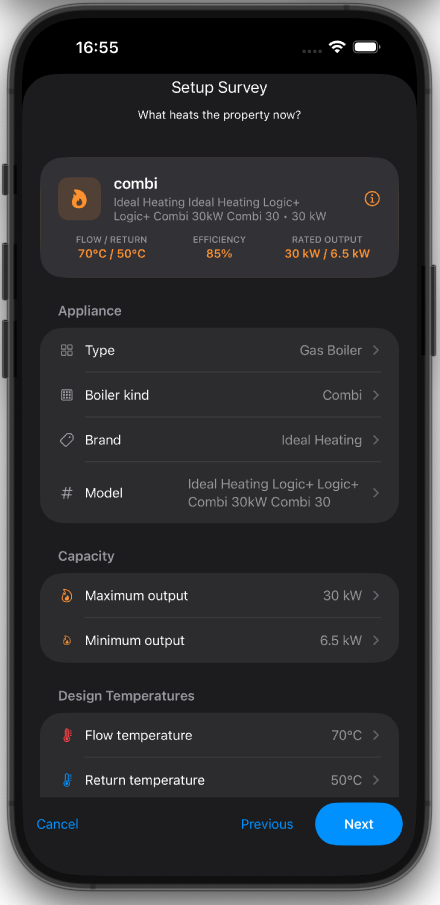
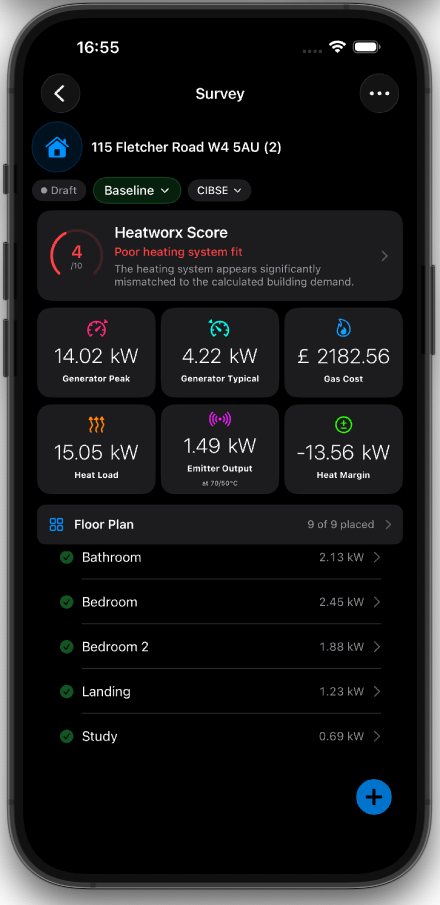
A starting pair, shown on the number. When you choose the heat source, the profile takes a conventional pair for that appliance: 70/50°C for a gas, oil or system boiler, 75/55°C for LPG and biomass, 45/40°C for a heat pump. That is a starting assumption in exactly the sense this guide means, a condition to test, not a claim about the house, and the emitter output tile carries it. Change the pair and the radiator outputs move while the heat loss stays put. If the temperatures are ever cleared on a wet system, Heatworx shows no emitter output, margin or score at all rather than falling back to the catalogue rating. Direct electric panels are not water-fed and are not corrected.
What the number means once it's set. Each radiator's catalogue output at ΔT50 is corrected to your temperatures with the simplified method used in this guide: the arithmetic mean water temperature minus the room temperature, over 50, to the power 1.3, the BS EN 442 exponent. The figure is printed with its temperatures on the tile, in the report and in the glossary. The calculation assumes balanced conditions, every radiator receiving the design temperatures with enough circulation. Heatworx doesn't verify that the pipework, pump, valves and controls can deliver that. That is system design and commissioning.
Testing the alternatives. Scenarios keep the baseline and try another set of conditions: the heat pump retrofit preset starts at 45/40°C and the low-temperature boiler preset at 55/45°C. The Low Flow Readiness report prices every radiator at three temperature pairs side by side, ending at 45/40°C, and lists the rooms that would need a bigger emitter.
Common mistakes
- Assuming the boiler setting is the radiator flow temperature. The configured boiler temperature doesn't necessarily match what reaches each radiator.
- Treating the return temperature as a known figure. Unless you've measured it under relevant conditions, it's a design assumption.
- Confusing radiator output with heat loss. Changing flow and return changes the radiator's available output, not how much heat the building needs.
- Assuming a radiator is adequate because the room feels warm. A system that copes on a mild day may struggle when the outside temperature reaches the design minimum.
- Choosing temperatures simply to make the radiators pass. Raising the assumed flow temperature improves the calculated output, but it doesn't prove the system can deliver those temperatures or run efficiently at them.
- Forgetting about circulation. A smaller flow-to-return drop needs more water flow for the same heat transfer. The actual system must be capable of providing it.
Quick questions
Can I measure flow and return temperatures during a heating survey?
Yes, with suitable temperature-measuring equipment. But the readings reflect how the system operates at that time, not its performance under design winter conditions.
What flow and return temperatures should I use for a gas boiler?
There isn't a universal answer. A pair such as 60/50°C is a reasonable starting scenario; the actual design must consider the boiler, the radiators, the controls and the intended operating conditions.
Why do heat pumps often use a 5°C temperature drop?
A smaller drop allows a lower flow temperature for a given mean emitter temperature, which improves heat pump efficiency. It needs higher water flow rates, so the pump and distribution must be suitable.
Does lowering the flow temperature reduce the building's heat loss?
No. It reduces the heat output available from the radiators. Building heat loss is set by the fabric, ventilation and design temperatures.
Does a lower flow temperature improve efficiency?
It usually improves heat source efficiency, particularly for heat pumps and condensing boilers. But the radiators deliver less heat, so their suitability needs checking.
Do I need to calculate water flow rates when surveying radiators?
Not for an initial assessment against assumed design temperatures. The final system design must provide enough circulation to deliver the required heat.
The bottom line
When you carry out a heating survey you probably don't know the actual flow and return temperatures of every radiator in the property, and you don't need to know them to calculate the building's heat loss. But to assess whether the existing radiators are big enough, you have to choose the water temperatures they're expected to operate at. Those temperatures are design assumptions. Change them and the radiator outputs change dramatically, even though the heat loss stays exactly the same.
The aim
Not to find the temperatures that make every radiator look big enough. To establish what temperatures and emitter sizes would be needed to heat the house properly, and leave the detailed system design to work out how to deliver them.
Sources and further reading
- CIBSE Domestic Heating Design Guide 2026 (paywalled)
- MCS MIS 3005-D Issue 3.0, Heat Pump Design Standard, clauses 5.5.4 and 5.5.5
- Approved Document L, Volume 1, England, 2021 edition incorporating 2023 amendments, paragraph 5.10
- Approved Document L, Volume 1, England, 2026 edition, effective 24 March 2027, paragraph 4.10
- Approved Document L, Wales
- BS EN 442, Radiators and convectors: standard output ratings and performance testing
Related guides
Calculation note
The radiator figures use the BS EN 442 correction with the standard exponent of 1.3 on the arithmetic mean water temperature, which is the method Heatworx runs; the logarithmic-mean comparison is shown for completeness. Flow rates assume water without glycol. No CIBSE table values are reproduced.